Title: Remembering What it Means to be Saved
All of us have walked into a room and completely forgotten why we went in there.
You stand there like a deer in the headlights.
You look around hoping the room will remind you.
Then you walk back to the room you started from, and suddenly it comes back to you.
Researchers have actually studied this.
Walking through a doorway seems to reset our memory.
And it’s not just rooms. It’s passwords.
How many of you have clicked “Forgot Password” more times than you’ve actually remembered it?
Or you reset your password because you’re convinced that you forgot it.
You enter a password that you think “Surely, I won’t forget this one.”
Then the website tells you, “Your new password cannot be the same as your old password.”
So, you actually remembered you password, but now you can’t use it.
The Christians in Galatia had the same problem.
They had walked through a doorway, from hearing the gospel and began listening to false teachers.
And somewhere along the way, they forgot how they came in.
They had been given the key to a relationship with God: grace through faith.
But someone convinced them they needed a whole new password.
So Paul walks them back to where they started.
He reminds them that they don’t need a new method.
They need to keep relying on the person that brought them into salvation.
And that’s what God wants us to do today.
Not remember why we walked into a room, or what the password is.
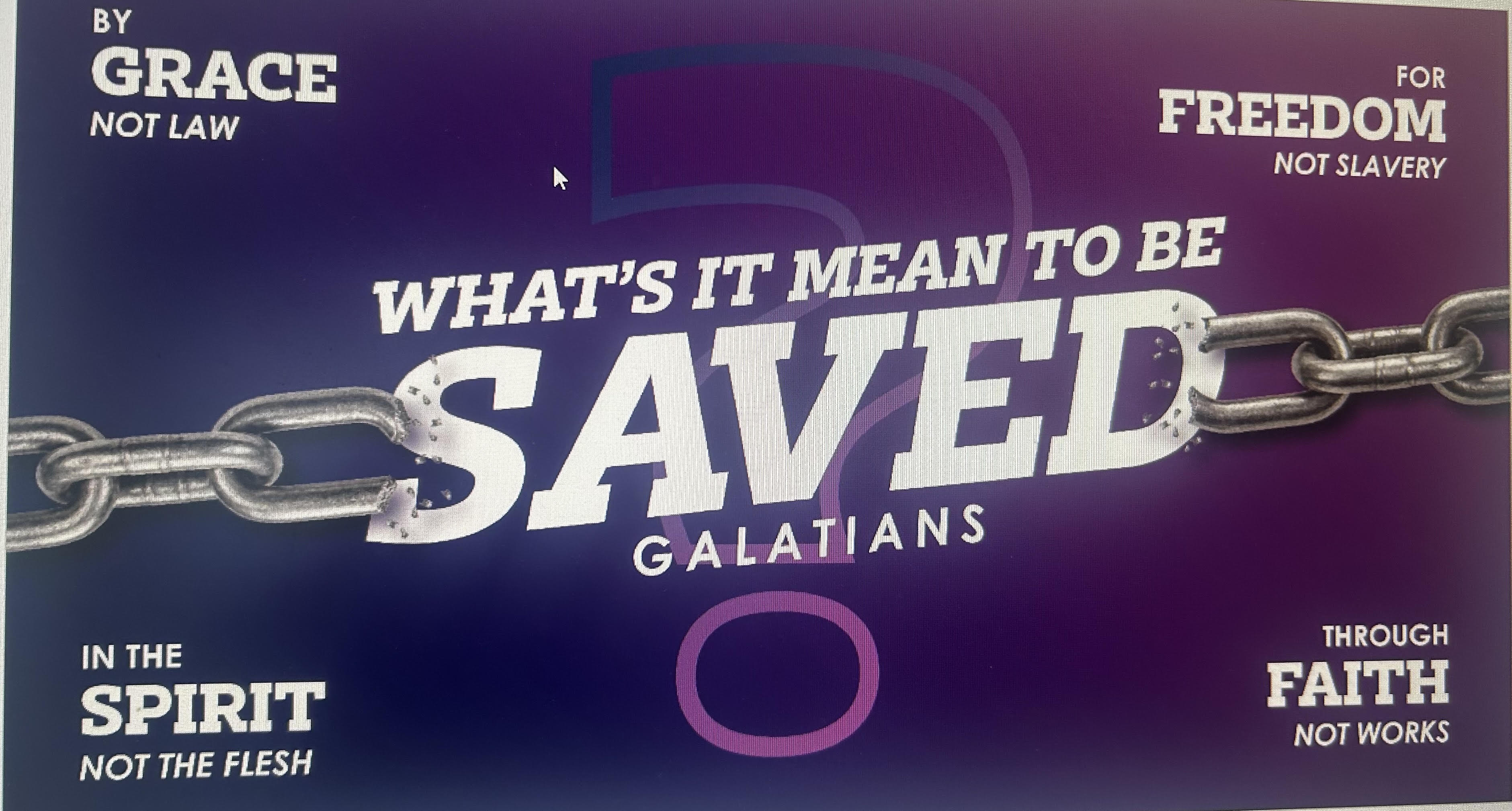
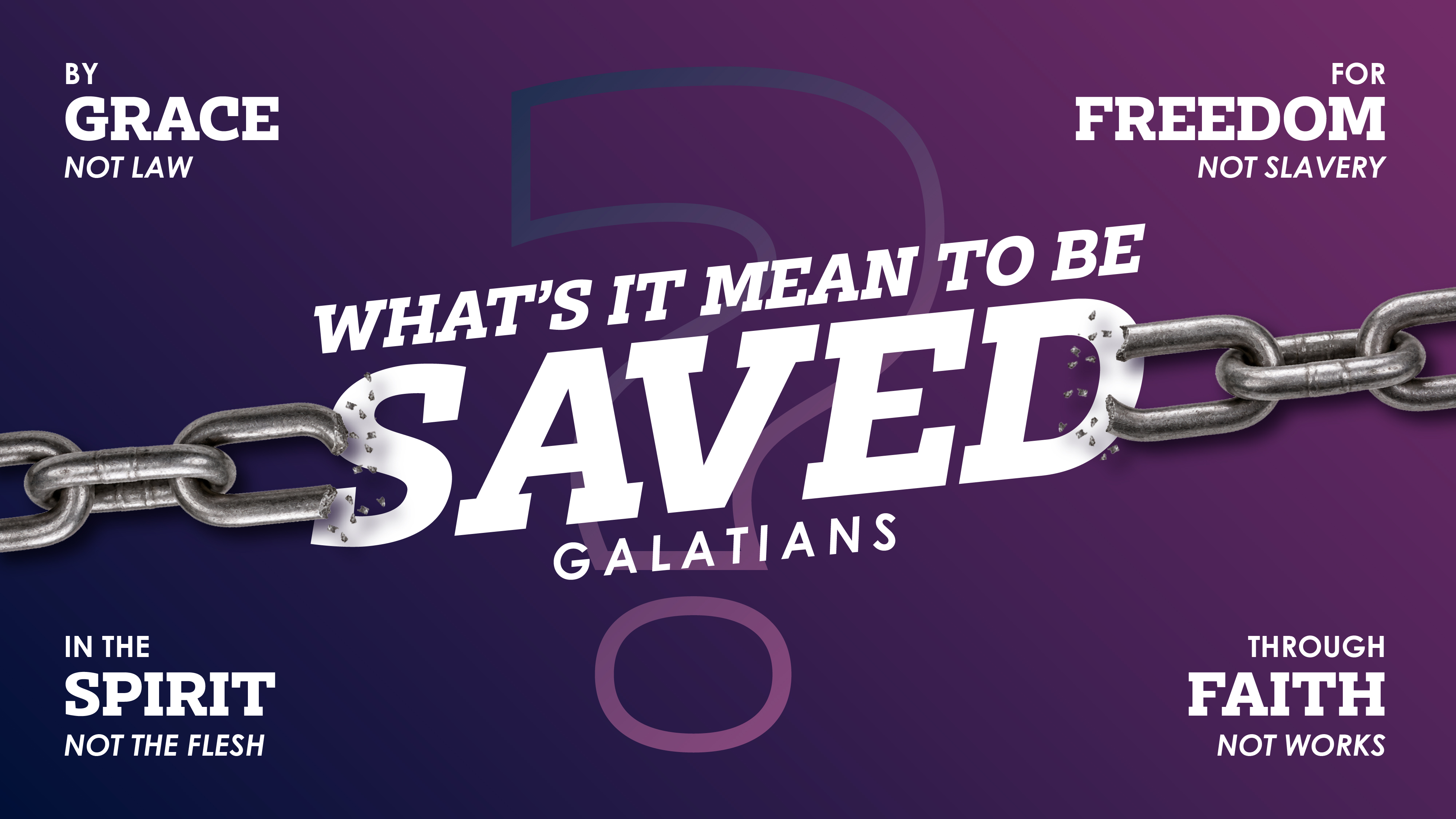
But Remember What It Means to Be Saved.
This is what we find the Apostle Paul is reminding the Galatian Christians about in Galatians 3
* 1 O foolish Galatians! Who has bewitched you? It was before your eyes that Jesus Christ was publicly
portrayed as crucified. 2 Let me ask you only this: Did you receive the Spirit by works of the law or by
hearing with faith? 3 Are you so foolish? Having begun by the Spirit, are you now being perfected by the
flesh? 4 Did you suffer so many things in vain—if indeed it was in vain? 5 Does he who supplies the Spirit to
you and works miracles among you do so by works of the law, or by hearing with faith— 6 just as Abraham
“believed God, and it was counted to him as righteousness”?
* 7 Know then that it is those of faith who are the sons of Abraham. 8 And the Scripture, foreseeing that God
would justify the Gentiles by faith, preached the gospel beforehand to Abraham, saying, “In you shall all
the nations be blessed.” 9 So then, those who are of faith are blessed along with Abraham, the man of
faith.
* 10 For all who rely on works of the law are under a curse; for it is written, “Cursed be everyone who does
not abide by all things written in the Book of the Law, and do them.” 11 Now it is evident that no one is
justified before God by the law, for “The righteous shall live by faith.” 12 But the law is not of faith, rather
“The one who does them shall live by them.” 13 Christ redeemed us from the curse of the law by
becoming a curse for us—for it is written, “Cursed is everyone who is hanged on a tree”— 14 so that in
Christ Jesus the blessing of Abraham might come to the Gentiles, so that we might receive the promised
Spirit through faith.
?- So what makes a person saved?
?- What’s the difference between a person who is saved and one who is NOT besides their eternal destiny?
Both may have attended the same church.
Both may have said the same sinner’s prayer and been baptized.
Both may doubt that they’re saved.
What we see in Galatians as well as other places in the NT is that the evidence of salvation is the indwelling
Holy Spirit.
In fact, that’s how Paul describes salvation in this letter.
He describes it as receiving the Spirit
He describes salvation as having been “begun by the Spirit.”
He calls our saving God “he who supplies the Spirit.”
The work of God through His Holy Spirit is the answer to both the questions
“How does one become saved?” and “How does one live as a saved person?”
And we will learn much more along these lines throughout the book of Galatians because being indwelt by
the Holy Spirit is a large part of “what it means to be saved.”
So, for the follower of Christ, when you wonder if your faith is saving faith…, -
1. REMEMBER THE SAVING WORK OF THE HOLY SPIRIT.
* 1 O foolish Galatians! Who has bewitched you? It was before your eyes that Jesus Christ was publicly
portrayed as crucified. 2 Let me ask you only this: Did you receive the Spirit by works of the law or by
hearing with faith? 3 Are you so foolish? Having begun by the Spirit, are you now being perfected by the
flesh? 4 Did you suffer so many things in vain—if indeed it was in vain? 5 Does he who supplies the Spirit to
you and works miracles among you do so by works of the law, or by hearing with faith— 6 just as Abraham
“believed God, and it was counted to him as righteousness”?
* 1 O foolish Galatians! Who has bewitched you? It was before your eyes that Jesus Christ was publicly
portrayed as crucified.
In this section, Paul cuts to the chase with his amazement with the foolishness of the Christians in Galatia.
If Paul’s mom let him use the word “stupid,” it’s what he would’ve used.
Instead, he calls them “foolish.”
He asks who it is that cast a spell over or hoodwinked them.
He’s assuming that they wouldn’t turn away from Christ without being tricked into doing so.
And the Christ they were turning away from had been obviously described as having died for them.
Paul uses language that describes his previous preaching of Christ’s crucifixion as being so clear that it was
as if they saw it done themselves.
2 Let me ask you only this: Did you receive the Spirit by works of the law or by hearing with faith?
Then begins a string of questions with obvious answers.
Neither they nor any other Christians receive the Holy Spirit by works of the law.
It’s always by hearing the gospel and responding in faith.
As I said a moment ago, salvation is described here as “receiving the Spirit.”
This is what we’re told in -
* Romans 8:9 9 You, however, are not in the flesh but in the Spirit, if in fact the Spirit of God dwells in
you. Anyone who does not have the Spirit of Christ does not belong to him.
I believe that this understanding of salvation makes a big difference between a fleshly church and a Spirit
led church.
Some churches treat salvation as something we do, like praying a prayer or getting baptized, and never ask
whether the Spirit has moved in.
Others swing the other way and treat outward displays as proof of spirituality.
Both can rely on the flesh, and both can miss what matters most: the importance of a transformed life.
The true test of the spiritual Christian is what we’ll learn about soon in 5:22–23 -
* Galatians 5:22–23 22 But the fruit of the Spirit is love, joy, peace, patience, kindness, goodness,
faithfulness, 23 gentleness, self-control
The rhetorical question of verse 3 moves on to ask about how the believer is sanctified - grows in Christ.
Paul asks, “Having begun by the Spirit, are you now being perfected by the flesh?”
The answer is no, believers are not perfected/sanctified by their fleshly actions.
We’re sanctified by the same Spirit working in us and who indwells us when we come to salvation.
5 Does he who supplies the Spirit to you and works miracles among you do so by works of the law, or by
hearing with faith— 6 just as Abraham “believed God, and it was counted to him as righteousness”?
The focus of Paul’s question in v. 5-6 has to do with the ongoing work of Holy Spirit among them.
It wasn’t by their fleshly efforts - just as Abraham’s salvation was through his believe not his works.
A rowboat moves by the strength of the boater’s arms.
A sailboat moves by the power of the wind.
Both require something from the boater, but only one depends completely on the boater.
The Galatians started in a sailboat, then decided to grab the oars.
The Christian life was never meant to be gutted out in our flesh.
Our job is to raise the sail and let the Spirit transform us.
What does it mean to be saved?
It means to receive the Holy Spirit by faith and not through good works.
It means to grow through the Holy Spirit working in our lives and not growing by the efforts of our flesh.
It means being saved the same way Abraham was saved - believing and having Christ’s righteousness
credited to our account.
So when you wonder whether God accepts you, don’t look at your performance.
Look at how you came into the relationship.
?- So what about spiritual disciplines like prayer, Bible reading & study, fasting, silence, and solitude.
?- Should these be seen as unimportant because they’re things we do?
No, they are very valuable.
But they don’t produce the growth.
They prepare the soil for the Spirit to produce fruit.
Spiritual disciplines are like a plow and fertilizer for our hearts.
They make our hearts more fertile ground for God’s grace to work in us through the Holy Spirit.
When you wonder if you really belong in God’s family…-
2. REMEMBER THAT GRACE THROUGH FAITH HAS ALWAYS BEEN GOD’S PLAN.
* 7 Know then that it is those of faith who are the sons of Abraham. 8 And the Scripture, foreseeing that God
would justify the Gentiles by faith, preached the gospel beforehand to Abraham, saying, “In you shall all
the nations be blessed.” 9 So then, those who are of faith are blessed along with Abraham, the man of
faith.
* 7 Know then that it is those of faith who are the sons of Abraham.
Paul shifts the argument away from the Galatians’ personal experience with Christ to the Old Testament.
Entering into a relationship with God by faith was not a new thing that came with the New Testament.
It goes as far back as Abraham, who was a pagan before God chose him and made a covenant with him.
And God declared Abraham righteous before he was ever circumcised, which was the very thing the false
teachers were demanding the Galatian Christians submit to.
This means that salvation was never about following legalistic requirements.
8 And the Scripture, foreseeing that God would justify the Gentiles by faith, preached the gospel beforehand
to Abraham, saying, “In you shall all the nations be blessed.” 9 So then, those who are of faith are
blessed along with Abraham, the man of faith.
God’s plan never changed.
From the beginning, it was to save people through faith in the Savior He would provide, and not just
Abraham’s descendants, but all nations.
That’s why Paul can say the gospel was preached to Abraham 2,000 years before Christ.
A good builder NEVER pours a foundation and then decides what kind of house it’ll be.
The plan comes first, and the house follows it.
God didn’t start with Law and switch to grace when Plan A failed.
Grace through faith was the blueprint before the first stone was laid.
Don’t ever let anyone pull some verse from the Bible and make you think that salvation isn’t by grace alone
through faith alone.
God’s plan never changed.
Your standing with Him doesn’t swing with your merit.
And your confidence in Christ doesn’t need to change depending on what part of the Bible you read from.
When your track record makes you think God must be done with you…-
3. REMEMBER IT’S ABOUT WHAT CHRIST DID, NOT WHAT YOU DO.
* 10 For all who rely on works of the law are under a curse; for it is written, “Cursed be everyone who does
not abide by all things written in the Book of the Law, and do them.” 11 Now it is evident that no one is
justified before God by the law, for “The righteous shall live by faith.” 12 But the law is not of faith, rather
“The one who does them shall live by them.” 13 Christ redeemed us from the curse of the law by
becoming a curse for us—for it is written, “Cursed is everyone who is hanged on a tree”— 14 so that in
Christ Jesus the blessing of Abraham might come to the Gentiles, so that we might receive the promised
Spirit through faith.
The truth is that, when you trust Christ as your Savior, your track record isn’t the one God looks at.
He looks at Christ’s track record.
Having shown that God has always saved people by faith, now Paul uses the OT to show that no one has
ever been saved by works.
Verse 10 can be understood more simply as -
3a. THOSE WHO CHOOSE TO DO MUST DO ALL PERFECTLY.
* 10 For all who rely on works of the law are under a curse; for it is written, “Cursed be everyone who does
not abide by all things written in the Book of the Law, and do them.”
The first evidence Paul gives here from the OT comes from the Law itself in Deuteronomy 27:26.
If someone is going to try to live according to the Law, they better DO it all, or they’re cursed, which
means to be under divine condemnation.
This is a curse that the OT Law itself states those who seek to live under the Law must DO ALL that the
Law requires.
Over the centuries many Rabbis diluted the warning of curses for those who didn’t follow ALL of the Law.
Some Rabbis taught that a Jew who was simply circumcised would never go to hell.
But this is what James writes in -
* James 2:10 For whoever keeps the whole law but fails in one point has become guilty of all of it.
in verse 11 Paul quotes Habakkuk 2:4 to make his point which basically states,
3b. SALVATION COMES BY GRACE THROUGH FAITH, NOT BY LAW THROUGH DOING.
11 Now it is evident that no one is justified before God by the law, for “The righteous shall live by faith.”
Not only does the OT tell us that no one is made righteous through the Law.
It also tells us that the way a person is made righteous is by faith not works.
Thank goodness God never intended for us to approach Him on our own merit.
In verse 12, Paul makes the point that it’s either one or the other, basically stating that -
3c. THOSE WHO CHOOSE TO DO RULE OUT BEING SAVED BY WHAT CHRIST DID.
12 But the law is not of faith, rather “The one who does them shall live by them.”
He shows this by quoting Leviticus 18:5
Either a person is saved by grace through faith or by Law through works.
verses 13-14 lay out the solution which came at Christ’s expense -
3d. SALVATION IS ONLY AVAILABLE THROUGH FAITH IN WHAT CHRIST DID.
13 Christ redeemed us from the curse of the law by becoming a curse for us—for it is written, “Cursed is
everyone who is hanged on a tree”— 14 so that in Christ Jesus the blessing of Abraham might come to
the Gentiles, so that we might receive the promised Spirit through faith.
It’s because Christ REDEEMED us which means He bought us out of the curse that our sin held us under.
Paul quotes Deuteronomy 21:23, where a criminal who was hung on a tree was declared cursed by God.
By Jesus’ day, crucifixion was understood to be included in this curse.
That’s why a crucified Messiah was a stumbling block to the Jews (1 Cor 1:23).
But that’s exactly Paul’s point.
Jesus wasn’t cursed for His own sin, but for ours.
What looked like God’s rejection of Jesus was actually God’s rescue of us.
Notice that God’s perfect work of redemption comes with two results (so that clause).
1. The blessing of Abraham (having a grace-based relationship with God) came to us Gentiles.
2. The Holy Spirit is able to be received through faith, which is evidence of our being children of God.
Think of the stage I’m standing on as being the relationship in which we’re meant to live with God.
We were free from shame, free from pride, free from the curse of sin and death.
When our first ancestors chose to sin, it’s like they took just one step down off the stage.
It didn’t look that bad because it was just one step.
But with that one step came the curse of sin.
Imagine that their next thought was “I can get back to where I was in my own effort.”
But that thought was a prideful one, sourced in their own strength.
And it minimized the nature of their rebellion.
As they took a step to get back onto the platform, the burden of their sin actually pulled them a step lower.
And so it went from that moment forward.
Every person since then has only become further distanced from God with every religious effort.
All of our personal efforts to fix our sin have only heaped upon us more sin of pride and self-reliance.
The good news of the gospel tells us that Jesus entered our sinful world.
Though He didn’t deserve to live under the consequence of our sin, He did.
Though He didn’t deserve to be grieved by our prideful religion, He still chose to experience it.
You know, something that comes with sin is the need to curb sin.
So, we have a whole system of punishments that help us sinners to curb the sin of our society.
And the worst punishment that could be imagined at the time that Jesus walked this earth was crucifixion.
Though Jesus didn’t deserve to die, He did and in the most grievous way that could be imagined at the
time.
Jesus’ death was an act of redemption that purchased forgiveness for all those who will repent and believe.
And by dying in the way that He did, He took our curse of sin on Himself.
Paul spent this chapter calling the Galatians to remember how they became saved by a miracle of the Holy
Spirit and not by a work of their flesh.
And Jesus gave us the Lord’s Supper so we would never forget how God’s grace flows to mankind.
* Matthew 26:26–28
o 26 Now as they were eating, Jesus took bread, and after blessing it broke it and gave it to the
disciples, and said, “Take, eat; this is my body.”
o 27 And he took a cup, and when he had given thanks he gave it to them, saying, “Drink of it, all
of you, 28 for this is my blood of the covenant, which is poured out for many for the
forgiveness of sins.